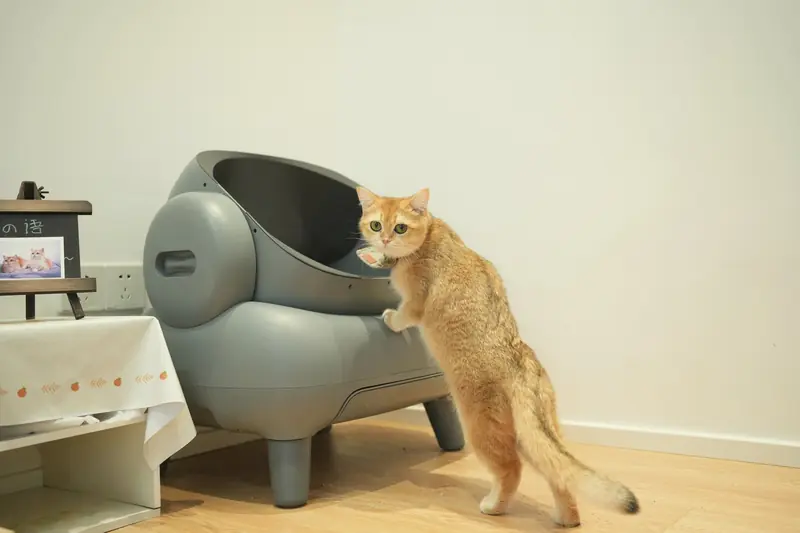
Best Self-Cleaning Litter Boxes
A self-cleaning litter box sifts or rakes waste into a drawer so you scoop less often. The decisions that matter are the minimum cat weight the sensors accept, whether your cat fits through the opening, and what the machine costs to keep running. This page is for owners of adult cats, multi-cat homes and anyone replacing a box that no longer keeps up.
Jump to section
What we look for
Minimum cat weight and sensor safety
sensors need a minimum weight to work, so kittens and small cats can fall outside what the box detects.
Interior size and entry height
a cat has to step in, turn around and squat comfortably, and seniors need a low step.
Waste drawer capacity
a bigger drawer means fewer trips to the trash, especially in multi-cat homes.
Litter type it needs
some boxes work with ordinary clumping litter and others need crystals or the maker's own product.
Noise and app features
a loud cycle can scare a nervous cat, and an app is only useful if it works without a subscription.
Ongoing costs
bags, trays, filters and special litter add up faster than the sticker price.
- Sources: manufacturer product pages and manuals, warranty terms, and the ASPCA litter box guidance for what a healthy litter setup looks like.
How to choose the right self-cleaning litter box
Self-cleaning boxes look alike in photos, so the spec table does the sorting. If you are still deciding whether to buy one at all, read self-cleaning vs regular litter box. If a cat is already avoiding its box, start with our litter box setup guide.
Minimum cat weight and sensor safety
Check the minimum cat weight in the spec table before you buy for a kitten or a small adult. Sensor-based boxes only run safely above the weight the maker states, and some makers suggest a manual or semi-automatic mode until a kitten is heavier. Read the maker's manual for that mode, and see our litter box setup guide for the weight example we cite. Also check the maximum weight if you have a large cat.
Interior size and entry height
Compare the footprint and the entry height columns. A big cat needs room to turn around, and an older cat may avoid a high step-over. Measure your space as well: many self-cleaning boxes are far larger than a plain pan. Open-top models suit cats that dislike enclosed spaces, which matches the ASPCA preference for uncovered boxes.
Waste drawer capacity
The drawer figure is the maker's estimate, so treat it as a guide. Your own number depends on how many cats use the box. Bagged or liner-based drawers add an ongoing cost. Emptying is still a task: ASPCA advises washing the box weekly and fully replacing the litter (ASPCA), so plan to do both whatever the box does for you.
Litter type it needs
Check the litter type column. A box that takes ordinary clumping litter gives you a choice of brands and lets you follow what your cat likes; ASPCA says cats generally prefer unscented, clumping litter with a medium-to-fine texture (ASPCA). A box that needs one litter locks you in. Our clumping vs non-clumping guide explains why that matters.
Noise and app features
Read the listing for any noise figure the maker states, and remember it is a maker claim. Apps can alert you when the drawer is full or the cat visits more often than usual. Check whether the box still runs from its own buttons if Wi-Fi drops, and whether the app needs an account.
Ongoing costs
Add up what the box needs over a year: replacement trays or liners, filters, charcoal pads and the litter itself. The spec table shows whether the box needs proprietary consumables. A cheaper box with expensive refills can cost more than a pricier one that takes ordinary litter. Our comparison of self-cleaning and regular boxes walks through the trade-offs.
Tips for using your self-cleaning litter box
- Keep one box per cat plus one extra, even if each box is self-cleaning. See the litter box setup guide for placement.
- Check the maker's weight limits for kittens before you switch a young cat to an automatic box. We explain the example in the setup guide.
- Look at your cat's habits for a few days after you switch. If it stops using the box, rule out a medical cause with your vet before blaming the machine.
FAQ
Are self-cleaning litter boxes safe for kittens?
Check the maker's minimum weight. One maker's FAQ states that its scale does not recognize cats under 3 lb (1.3 kg) and advises using semi-automatic mode until the kitten is heavier (Litter-Robot FAQ). Your vet can tell you when a kitten is ready.
Do I still need more than one box?
Yes. ASPCA advises one box per cat plus one extra, whatever the type of box (ASPCA).
Do self-cleaning boxes still need cleaning?
Yes. ASPCA advises washing the box weekly and fully replacing the litter (ASPCA), so follow the maker's schedule for trays and drawers as well.
My cat stopped using the box. Is it the machine?
Rule out medical causes first. ASPCA lists urinary tract infection, interstitial cystitis and stones (ASPCA), and Cornell says a urinary blockage is an emergency (Cornell Feline Health Center). Call your vet.
Related
-
Buying guide
Best Litter Boxes (Large, Low-Entry and High-Sided)
Size, side height, entry height and material for every cat.
-
-
Comparison
Self-Cleaning vs Regular Litter Box: Worth the Money?
Less scooping and more parts, or a simple pan you control.
-
Comparison
Clumping vs Non-Clumping Cat Litter
What cats prefer, how scooping works and what fits your box.
-
Guide
Litter Box Setup: How Many, Where, and How Often to Clean
Box count, placement, litter depth and cleaning schedule from ASPCA and Cornell.
Get the Cat-Ready Home Checklist
A printable checklist built on AAFP, ASPCA, Cornell and FDA guidance, from how many litter boxes you need to which flowers to keep out. Free, and sized for the fridge door.